



January 2026
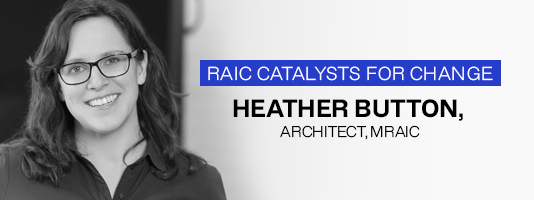
To celebrate and honour RAIC volunteers, we are pleased to introduce you to Heather Button, MRAIC.
Thank you, Heather!
1. Why did you decide to become an architect?
At six, when my parents bought a subdivision house off plans, we’d walk the framing site, which fascinated me. There’s a photo of me with my dad. By the time I was twelve, I’d designed houses and fashion, but wasn’t a visual artist. I went to an arts high school for music instead. My mom took me on a tour of local universities in the GTA, and I remember entering the School of Architecture at the University of Toronto, seeing a scale framing model they had on display for their open house, and thinking… that’s a career? I started researching the programs and applied a year later.
An architectural education is excellent for many careers. I am forever grateful to the co-op program for giving me experience in firms so I could understand what the career entailed. I got my license and became an architect because of the positive changes we can make for the public. We influence everything, from the sidewalks we walk on, to the spaces where people live and feel safe. Even minor renovations often bring buildings up to new code requirements that help with accessibility.
2. How long have you been an RAIC member and what do you see as the value of your membership?
I’ve been a member since 2019. The value of the RAIC’s membership is that its purpose is to make genuine change while celebrating architecture in all the ways it influences culture. My membership allows me to connect with people nationally, who are doing interesting things in other provinces that might create lessons learned for the region I work in. Also, there’s something wonderful about seeing different parts of Canada with every conference.
3. Why do you volunteer for the RAIC?
I want to address why people should volunteer. Sure, there are countless demands on our time. But we have an expertise that is valuable to the community, and training that helps us navigate complex human relationships. Volunteering provides us with an opportunity to connect with like-minded individuals who want to create the change they envision. I can say without hesitation that any time I volunteer for anything that resonates with me, I feel rewarded and gain inspiration, wisdom and insight.
Volunteering for the RAIC is a great way to create change in Canada. For me, volunteering through the RAIC connects me to the people who propose changes and sit in places that make the standards we must meet or exceed when designing buildings. Because the RAIC is a national organization, we can leverage this interconnectedness to lobby the government for necessary changes at all levels: municipal, provincial, and federal. And it’s often the federal level that influences the provinces to make the changes that affect the way we build.
4. What do you find most challenging about working as an architect?
The most challenging thing about working as an architect is when I work on publicly funded projects governed by requirements that are tied to very specific funding models. We must work with them to make sure the project moves ahead, but these requirements don’t always make sense for the project specifics. Sometimes there are new bodies of research with evidence that proves different requirements may be more beneficial for everyone. It takes a long time for public projects to catch up with the research being developed. This happens in everything from sustainability and construction practices to evidence-based research for Long-Term Care facilities.
5. Why is this area of advocacy important to you?
At a broad level, my work as co-chair of the Long Term Care Working Group is important because how we address our most vulnerable population speaks more about us as a society than just about anything else. The staggering number of deaths that occurred during the pandemic in the Long-Term Care facilities broke my heart. There is a better way. Any steps we take to help the vulnerable and marginalized populations are helpful for all of our society. On a personal level, we all age. As part of the current sandwich generation, we’re trying to take care of both our aging parents and our own children. Creating better spaces for our loved ones is necessary. This is both for our peace of mind but also for their continued happiness and well-being. Eventually, we’re all confronted with what aging means, and if I can make it better, then we all benefit.
6. What do you think will most change/shape practice over the next five years?
Climate change primarily. Climate change affects the most vulnerable citizens first because of where they live in the world, which is most affected by climate change. Seniors with ailing health will be affected. Insurance premiums will go up, forcing building owners to take measures we’ve already been trying to address with building science, and governments are going to have to step up so that their infrastructure is ready. That’s a lot to do within a challenging political economy.
7. What role do you see the RAIC and architects playing in terms of climate action, truth and reconciliation, equity and justice, procurement reform, among other issues that matter?
The RAIC and architects are key members in creating the changes we need to see. As architects, we have a duty to the public to create buildings and spaces that create a positive legacy for the future. The RAIC, by not being in control of our licenses, means that it can step up to advocate for change in a way that the provincial governing bodies cannot because the provinces support their self-governance. The RAIC can lobby all levels of government and has programs in place to educate the public both on what we can do, and what science tells us are best practices for just about any built form.
8. What advice would you have for those looking to get more involved in advocacy causes related to architecture?
Whether it’s fundraising for a not-for-profit you support, becoming a working group member for any of our standards, or volunteering to represent your professional organizations, there is a place for you. Look for opportunities tailored to the intersection of your skill sets and passions. They’re everywhere. That’s how I ended up on the Long-Term Care Working Group: I saw the email asking for members. My direct expertise is not as strong as some experts on the committee, but it’s adjacent, and my skill set serves best by lifting others up. So, joining the Working Group, and now being co-chair has helped me support the experts both in the Working Group and outside of it. If you come with a willingness to learn and serve, you’ll be amazed at the opportunities that arise.
9. How do you incorporate diversity, equity and inclusion in your work environment, the built environment and your volunteer work?
In our office, I’m proud to be part of a diverse firm. The coworkers in my medium-sized office of 30 people speak 17 different languages, and my coworkers’ perspectives are crucial to better understanding the world in which I live. In my volunteer work, I see myself in a position to lift voices that aren’t given space, drawing on expertise and hopefully creating a safe place for people to speak up when they have something important to say. In my projects, I often work with marginalized people, so bringing them to the table is crucial to creating a project for them.
10. What do you like to do outside of architecture?
I write for myself to process what’s going on in the world. I crochet. And whenever possible, I like to both travel and take in things happening where I live with my family. New experiences bring new insights and create more well-rounded architects.