The RAIC developed Four Case Studies Exemplifying Best Practices in Architectural Co-design and Building with First Nations as a resource for architects, Indigenous communities, policy makers, and project funders. These case studies offer tangible insight into how collaborative design processes can center Indigenous priorities, knowledge systems, and aspirations in the built environment.
Architecture, as a public-spirited profession, has an essential role in reconciliation, especially when Indigenous people are positioned as decision-makers in shaping their communities. These case studies highlight how a co-design process rooted in respect, relationship, and responsiveness can result in buildings that support cultural identity, wellbeing, and community development.
The work builds on the foundation laid by the 2017 RAIC International Indigenous Architecture and Design Symposium, where Indigenous architects and leaders from Canada, Aotearoa (New Zealand), Australia, and the United States identified best practices for co-design. These principles continue to be carried forward by the RAIC Indigenous Task Force and Truth and Reconciliation Task Force.
Overview
Each case study represents a different asset type—school, cultural centre, administrative/business centre, and housing, reflecting the diversity of infrastructure needs in Indigenous communities. The stories shared by leaders, architects, and community members illustrate how built form can embody values, teach history, and support intergenerational knowledge.
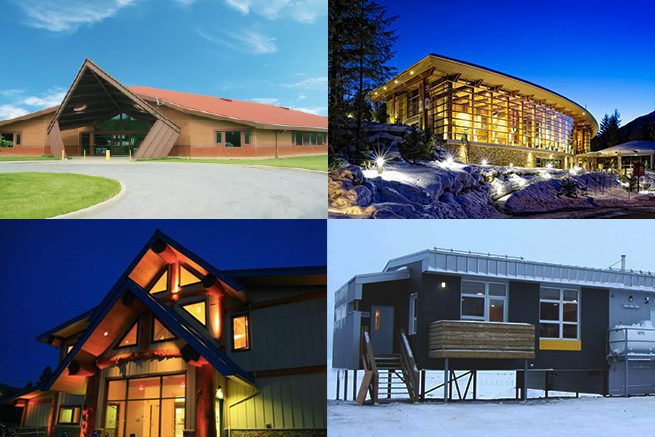
The projects span three First Nations and one Inuit community across Canada, demonstrating a range of design processes, governance structures, and cultural contexts. While the approaches differ, the core theme remains: architecture must emerge from community vision, respect for land, and culturally grounded collaboration.
Funded by Indigenous Services Canada and authored by Louise Atkins, these case studies serve as both inspiration and guidance. They offer a clear reminder that meaningful reconciliation is built, literally and figuratively, through sustained partnerships, Indigenous agency, and architectural excellence.
Summary of Best Practices
Best practice insights from these studies can inspire communities and help shape government funders’ policies and practices.
Interviews were conducted with architects and designers, Indigenous chiefs and community leaders, Indigenous government employees, contractors, and construction company officials, academics, and government funders. Questions posed in interviews built on best practice themes from the RAIC International Indigenous Architecture and Design Symposium as well as value-added considerations such as Indigenous employment. Best practice findings are divided into four groups.
Project Initiation
The impetus for each project was different. Some were replacement assets.
The Six Nations of the Grand River were replacing one-room schools dating from the early 20th-century.
When the Splatsin te Secwepemc lost their “Log Cabin” convenience and artisan craft store in a fire, they replaced it with a much larger business hub, artisan marketplace, and offices.
The Squamish and Lil’Wat First Nations leveraged the opportunity of the 2010 Olympic Games to create a cultural centre as a showcase to the world in their shared traditional territory of Whistler, BC.
In Nunavik, the major stakeholders came together to design, build and monitor a pilot duplex house that could be a prototype for sustainable northern housing that is culturally responsive, better adapted to climate change, and highly energy efficient.
Co-design Process
Co-design is the collaborative design process between the architects and the Indigenous community as client. In the four case studies, best practices included architects listening carefully to understand the community’s vision, and working closely with the client throughout the design phase. The resulting building designs were anchored in Indigenous peoples’ connection with the natural world and reflected who they are as people – their traditions, culture, values and lifestyles, and their aspirations.
Co-design is not a formula. In each case study, co-design took its own distinct form. In one project, the architect worked with a large steering committee of Indigenous chiefs and stakeholder officials. Another included Elders as well. A third used a design charrette with a cross-section of Indigenous tenants and a fourth added community open houses to the process. Two of buildings were designed by Indigenous architects, and two were by architects and designers with experience working in Indigenous contexts.
For all four projects, Indigenous respondents underlined the importance of architects who listen well to the community vision and engage in ongoing dialogue. Through an iterative process, the architects brought design options and solutions until their clients were satisfied that their vision developed into a tangible design that met functional requirements and reflected their values, culture, traditions, lifestyles, and aspirations.
Designs referenced ancestral building forms and Indigenous peoples’ reverence for and relationship with the natural world. In every case example, the buildings were anchored to their natural surroundings and most integrated traditional materials, particularly wood. Each project maximized energy conservation through mechanical means, insulation, and designs that utilized natural heating, cooling, and air circulation systems.
The buildings were further enhanced through siting, orientation and natural light. In keeping with Haudenosaunee traditions, Emily C. General School is oriented to the cardinal directions, tracking the sun through the days and seasons.
Following Squamish and Lil’Wat traditions, entrances to their cultural centre face east. For the Nunavik pilot duplex, reversible front entrances are an architectural innovation that allows optimal positioning of every house for solar gain and bright living spaces.
Architects and designers and their clients carefully shaped the interior spaces, commissioned artists’ installations and added historical and contemporary artifacts to convey the cultures and facilitate traditional practices and teaching.
For example, visitors to the Quilakwa Centre and band members alike can sit and enjoy their Tim Hortons coffee among massive log posts and beams carved with images of bald eagles, salmon, fish, and scenes of traditional Splatsin life.
Building Process
Each community took a hands-on approach to the building process. Strong Indigenous community capacity was demonstrated in project oversight and management. Indigenous construction firms and entities employing Indigenous workers in a broad range of skilled trades built major portions of the projects. Leaders stayed involved and committed the necessary resources to ensure project completion. These best practices could be formulated into a guideline enabling First Nation funders to recognize and assess capacity and shift control of capital projects to qualified First Nations.
Steering committees continued to play an important oversight role, guiding development and consulting with architects, designers, and construction managers, right through to project completion.
These buildings and facilities were built by Indigenous people. Project management and the majority of the construction was done by Indigenous-owned entities employing local Indigenous tradespeople, exemplifying best practices in employment, skills development, pride in the work and a sense of community ownership of the completed buildings. In every case, these buildings are highly-valued by Indigenous community residents and continue to be well-maintained.
First Nation leaders interviewed for the case studies believe that for communities with proven track records in building projects which are on-specification, on-time, and on-budget, the funding agencies should objectively assess and recognize this capacity and pass control to the First Nation for all aspects of their building projects.
Two case study projects involved First Nations who were large or sole funders of their buildings. The Quilakwa Centre was completely self-funded by the Splastsin First Nation through a combination of insurance and trust funds and loan financing. Large cultural complexes are expensive to build, and despite contributions from all levels of government and the private sector, a large funding gap remained for the Squamish Lil’wat and Squamish Cultural Centre. Both First Nations contributed their own band resources and business know-how to get the projects done.
For all four projects, Indigenous leaders were determined to complete their projects to reflect community identity and become a base for cultural reclamation and growth.
Outcomes
Indigenous respondents all felt that the impact of their co-designed buildings was significant, with positive, far-reaching outcomes.
They appreciated the role the architectural co-design process played in creating buildings that resonate with the community and will be of lasting value.
Architectural innovations exemplified in these projects have since been applied more broadly to other building projects. Enter your answer here.